

Shimano, SRAM, Campagnolo, and others release new groupsets every year or every other year. Usually, the changes aren’t that exciting nor all that groundbreaking. But with the popularity of off-road riding (ie., gravel riding and cyclocross) on a road bike, a frame can take a beating.
So, SRAM, the American road and mountain bike component maker, with its new 13 speed groupset, caters specifically to gravel and cyclocross riders. While big improvements have been made in the shifters’ ergonomics and stronger braking, the most unique upgrade of the group is in the rear derailleur. More specifically, how the derailleur is installed on a bike. There is no front derailleur because there is only one chainring.
How is a Rear Derailleur Usually Installed On a Bike?
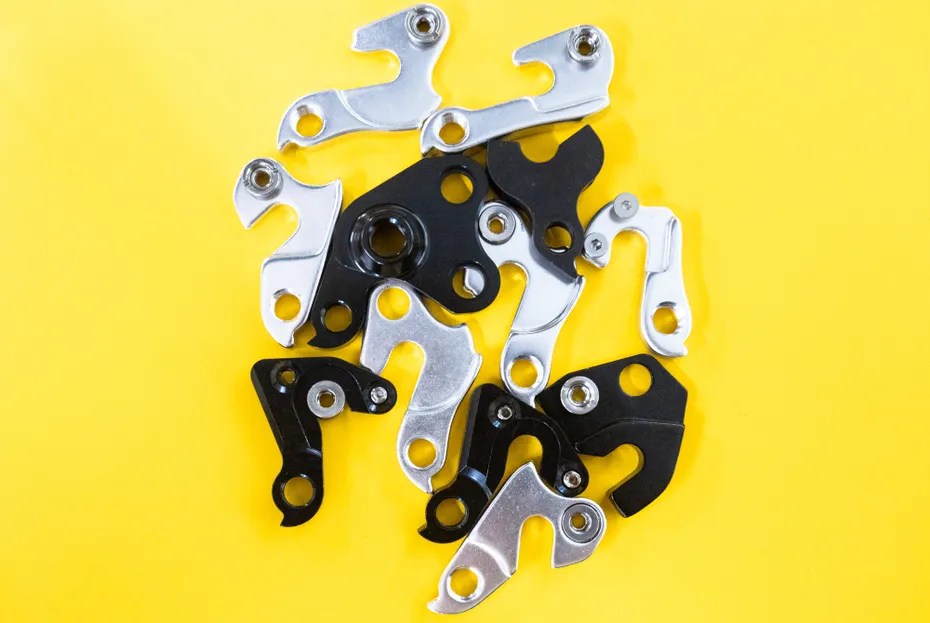
When steel bikes were all the rage, the rear derailleur was attached directly (screwed in) to the rear dropout. If a mishap occurred, such as a crash or some other kind of incident and the derailleur got knocked out of alignment, it was fairly easy to bend the frame back into place. If that didn’t work, you’d either have to buy a new derailleur or even a new bike frame.
When aluminum, carbon, and titanium bike frames began to be produced, the ability to manipulate the frame after an accident or crash became an impossibility. Enter the replaceable rear derailleur hanger. The “hanger,” as it was called, would screw into the rear dropout with a place to connect (screw in) the rear derailleur (see picture above).
The Derailleur Hanger Dilemma

The problem with derailleur hangers is once they are bent or damaged in some other way, it can be difficult to readjust them. That means your shifting will be out of alignment and you risk not only destroying your rear derailleur but also potentially damaging your wheel.
And it doesn’t take just a severe accident to bend the hanger, it can get bent from a bike just falling over on the drive side or even when a frame is shipped from one place to another. If the hanger can’t be straightened, then a new one will need to be installed.
The problem is that derailleur hangers are very bike specific and it can be difficult to sometimes find a replacement. However, that dilemma has become less of a problem in recent times with the internet and companies like Silca using 3D printing.
SRAM’s Universal Derailleur Hanger (UDH)
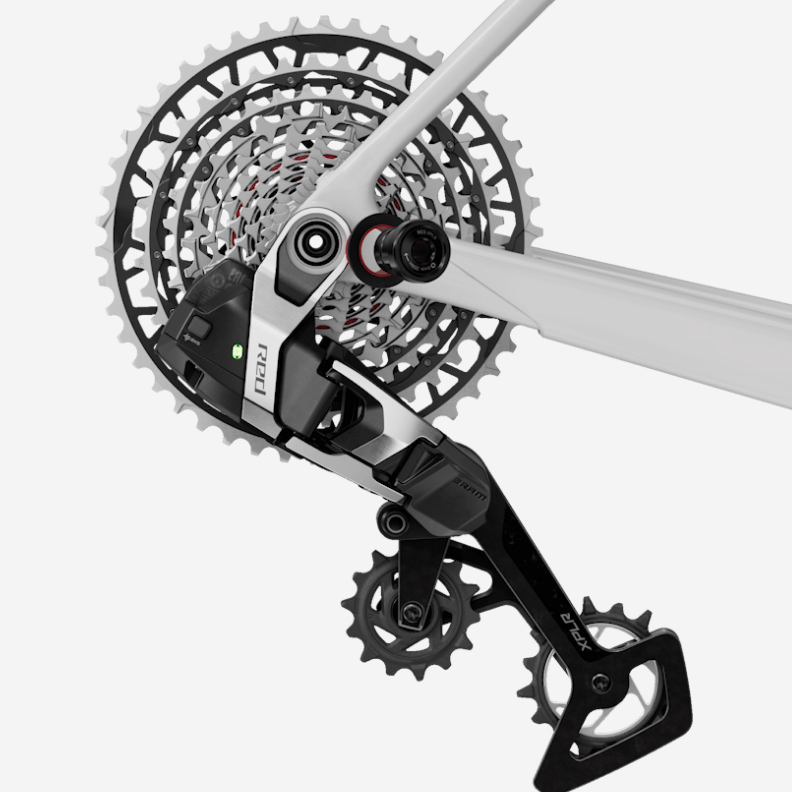
In 2019, SRAM decided to go “old school” and make a derailleur that attached directly to a bicycle frame’s rear dropout and to bypass a hanger altogether. Not only that, if a crash occurs, “Rather than bend or break, SRAM designed the hanger to pivot backwards in the event of the chain jamming. If the hanger pivots backwards, you can push it forward, often without needing to loosen the thru-axle.”
SRAM attempted to make its UDF an open standard and many cycling brands have adopted it for mountain bikes, and in SRAM’s case, it uses it on their new gravel 13 speed, Red groupset. But the company’s innovation doesn’t stop there.
If a stick gets lodged in one of the rear pulleys, the geared portion will continue to rotate. Additionally, adjusting a rear derailleur can sometimes be a game of fine-tuning limit screws to dial in accurate shifting. This new derailleur eliminates the need for them.
Last Thoughts

SRAM’s latest group release for gravel riders looks amazing. Shifting and braking look top-notch, so it would be great to see this new tech make its way to new or future bikes but also be available for current bikes.
Right now, if you want to take advantage of a UDF, it looks as though you may have to purchase a new frame. If you are a hardcore gravel rider and your bike supports it, the new SRAM Red group looks like a good investment. But if you ride mostly road and some gravel, maybe wait to see if this newer tech eventually becomes available for roadies.

Share this:


 Bicycle Day Trips - Bicycle Travel, Gear Reviews, Photography, Cycling News, and Commentary
