

Now that we are firmly ensconced in the fall season despite the occasional warm temperatures, the days are shorter, minus the humidity of the summer, and are cooler. That means if you continue with your riding into the colder months ahead, you’ll need to outfit your bike with lights.
Ideally, though, you should have both a front and rear light affixed to your bike. If you don’t currently have either one, you should. Bike lights are not just for night or early morning riding. They should be illuminated every time you go out, even on a bright sunny day. That idea is the motivation behind a campaign started by Australian pro racer for Cofidis Rachel Neylan called “Be Bright Wear a Light.”
What is the “Be Bright, Wear a Light” Campaign All About?

Neylan launched the “Be Bright Wear a Light” initiative in response to the large number of cyclists, both pro and amateur, who have been killed or injured while on a daytime bike ride. So far, she has received support from Tadej Pogačar, the two-time Tour de France champion, as well as Elisa Balsamo, another world champion.
Daytime running lights (DRLs) have, amazingly, been supported by the car industry for many years. Research even supports their effectiveness. In fact, as restated in this article over at Bicycling.com, DRLs can reduce accidental deaths by 6%.
In the world of cycling, a study was done where 1,845 lights were installed on bikes for 12 months. The data collected showed that personal injury to cyclists was reduced by 19%.
Trek, the bicycle manufacturer and travel company, took this even further when marketing their own DRL. It says that overall there was a 33% decrease in bicycle accidents, and the company goes as far as to claim that a cyclist is 230% more visible with a DRL.
Viewpoints About DRLs from the Cycling Community
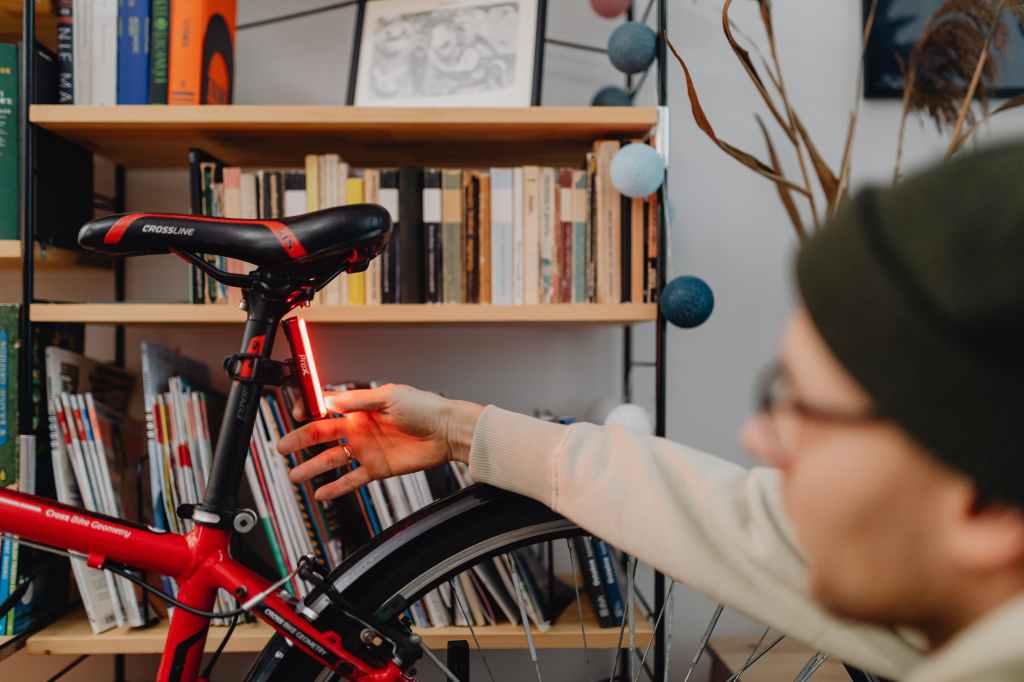
Views about using lights or wearing a helmet, however, have been met with some resistance by those in the cycling community. Generally, people don’t like to be forced to do something. Look at the ongoing resistance in the motorcycle arena to wearing a helmet.
My view is that although cycling is a wonderful and beautiful sport, it is inherently dangerous. And if you ride your bike on the road, that danger increases tenfold, even if you are the type of cyclist who strives to do all the right things. So, if you can do something very simple like adding lights to your bike to be more visible to motorists, why wouldn’t you?
Types of DRLs On the Market

There are a wide variety of front and rear lights available at various price points for bikes. Personally, the best ones I’ve used are the Raveman as a front light and Garmin’s Varia for a tail light.
The Varia is an excellent product. It will even integrate with your Garmin computer (or Hammerhead, Wahoo, etc.) and give you on-screen notifications about approaching cars. What cars see, as they come up behind you, is a bright flashing light. The Varia also has a couple different flashing modes and a solid mode. The other nice point: no more replaceable battery. The Varia can be charged over USB and that charge will usually last me a couple rides.
A good front light is harder to find, especially one that won’t take up room on your handlebar. With an extended Gamin mount (or a third-party mount similar to the Garmin), you can connect both your bike computer and your front-facing light.
The Raveman is both an excellent DRL and a very bright light for twilight/ night riding. So far, its runtime is quite long, but while it charges over USB C, it takes a long time to reach 100%
Many cycling companies have adopted Garmin’s radar technology, such as Trek, Cannondale, and Cycliq (which is basically a Varia with a camera function). While a Garmin Varia can be quite expensive and a Raveman will run around $45.00, it really doesn’t matter what you use. As long as you have front and rear lights that support a long run time and are bright, your overall safety on the road will be increased.
Last Thoughts
While not mandatory items, installing lights on your bike can increase your safety while out on the road. You might ask why the responsibility to be more visible on the road falls on cyclists and none of it on motorists? But that is a hard question to address.
Lights are not a panacea against a traffic fatality, but they are one more additional step you can take to avoid that situation. Of course, and overall, you should try to ride defensively, to wear bright apparel, and to obey the rules of the road.
But I think a campaign like “Be Bright Wear a Light” is an excellent idea. I hope that an initiative such as this one means fewer cyclists are hurt or killed in the future.

Share this:


 Bicycle Day Trips - Bicycle Travel, Gear Reviews, Photography, Cycling News, and Commentary